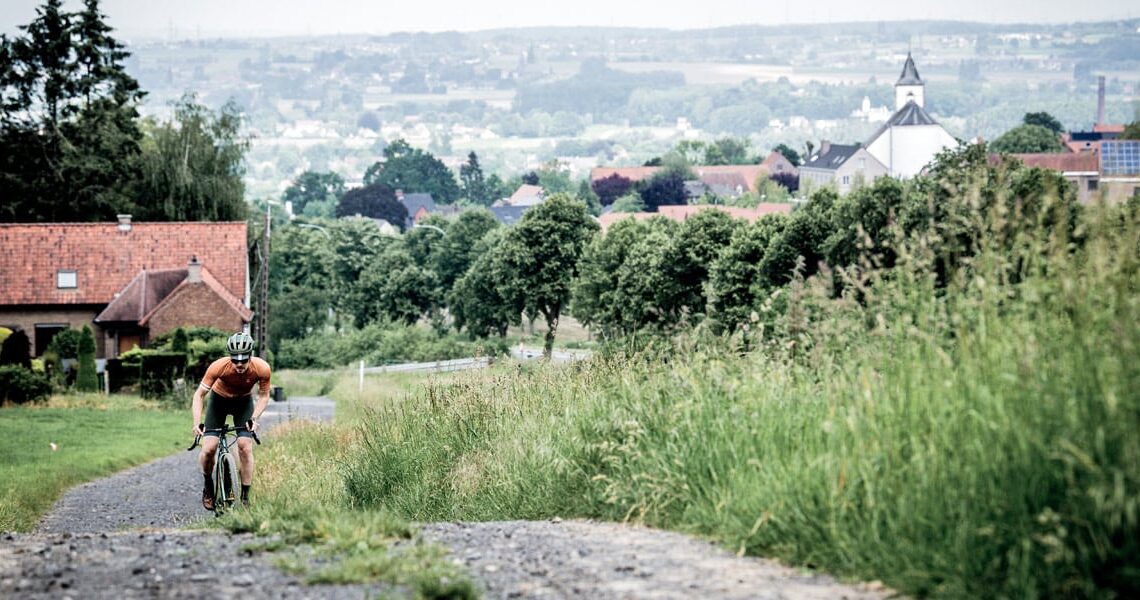

Flanders has long been defined by its brutal cobbles, steep bergs, and Spring Classics history—but there’s a new rhythm emerging beneath the stones. As gravel riding explodes across Europe, Belgium’s cycling heartland is evolving, blending its iconic climbs with a growing network of dirt roads, forest tracks, and bikepacking routes. The result? A fresh way to experience legendary terrain—where the Koppenberg meets quiet gravel lanes, and the chaos of race day gives way to long, immersive rides through history, countryside, and a cycling culture that’s once again reinventing itself.
~ Flanders is synonymous with the narrow cobblestone roads that are the backbone of Belgium’s spring classics. But until recently this cycling mecca was not known as a destination for gravel riding. Now, as more and more cyclists are pursuing gravel alternatives, its image is changing and the region is investing heavily in an expansive gravel infrastructure.

“The gravel scene evolved a lot the past few years. Many road riders discovered the beauty of gravel, which led to the increase in gravel events, bikepacking events and gravel routes in Flanders,” said Vincent Van Parys, an avid gravel rider and the founder of Secteur Pavé, a custom bike shop in Mechelen. “Some gravel events are more competitive while others are very laid back, with beer and French fries at the finish.”

While Van Parys said that a competitive focus has become a large part of the gravel scene in Flanders, the leisure aspect is also thriving. “A lot of riders still want to ride in nature, spend a long day on the bike and have a good time with like-minded cyclists,” he said. “It’s not all about aero gains.”
A lot of cyclists in Flanders have multiple bikes so they can swap between road and gravel. But in the past few years the “all road bike” has really become popular and some riders swap wheelsets to have a multipurpose machine. In addition, mountain biking used to be a winter sport in Flanders but today a lot of cyclists prefer switching to their gravel bike so they can keep the same position on the bike instead of riding a flat-bar bike with a different geometry.

Van Parys left the corporate world nearly a decade ago to focus on cycling, with an accent on gravel riding and bikepacking. Secteur Pavé specializes in high-end custom orders and today, he said, gravel and all-road bikes make up nearly 80 percent of his sales.

The rise in gravel riding would not be possible without sufficient infrastructure, and VISITFLANDERS has been central to the recent evolution. Few organizations are as active in cycling as VISITFLANDERS, but while the region’s spring classics attract thousands of tourists every year the tourism office sees gravel as a logical extension of the road scene.

Not surprisingly, it has developed several gravel routes that mirror great classics like De Ronde van Vlaanderen and Ghent–Wevelgem while others mirror the competitive gravel scene with circuits that follow Dwars door het Hageland, the premier pro gravel race in Flanders, or the upcoming UCI World Gravel Championships circuit.

For cyclists who love the cobbled climbs but are less enamoured with the heavily trafficked roads in between, well-marked circuits are now available, linking the cobbled sections with gravel roads and paths and offering enthusiasts a new cycling experience. In many ways the fusion between gravel and cobbles is a natural. After all, the stones were simply used to reinforce the original dirt roads of Flanders.
Van Parys was our guide on three of the region’s new gravel routes.

1. De Ronde van Vlaanderen Circuit
Rolling out of Ghent, we first stopped at Jaegher Atelier, a new cycling hub on the city’s outskirts, to grab one last coffee. We then hit the bike path alongside the Schelde River to Oudenaarde to join De Ronde van Vlaanderen gravel circuit, a well-conceived 86-kilometer loop. Van Parys climbed with comparative ease the classic’s famed cobbled hills, the Koppenberg and Oude Kwaremont. “It sure is a lot easier tackling these climbs on a gravel bike,” he laughed. But he also enjoyed discovering the gravel roads and single track paths in between. “Some of these are pretty technical in their own right,” he said. “But it’s a great circuit. And I love finishing in Oudenaarde. It holds a special place in cycling, and it also happens to be a great place to grab a beer after a good ride!”

2. Ghent–Wevelgem Circuit
Later in the afternoon we traveled north to explore the Ghent–Wevelgem circuit, a 91-kilometer loop that took us out of Ypres through the Flanders Fields and up the famed Kemmelberg. A remote single track path took us to Ploegsteert, the long-time home to late Belgian cycling hero Frank Vandenbroucke. We had a quick stop at the village’s Café de la Grande Place, which still celebrates the legend known as VDB.


The Ghent–Wevelgem loop, however, would not be complete without a healthy dose of Flanders Fields, and as we made our way up the Kemmelberg we spotted signs for the Lettenberg Bunkers, a grouping of bunkers strategically built into the hillside during World War I. They could be easily overlooked as the bunkers are found on a quiet back road. Once there, access is easy, and Van Parys walked his bike down to examine them. There was a stillness in the air sitting next to the bunkers, and even during our short break it was impossible not to reflect on the battles that were waged here over a century ago.

Continuing, we followed signs to the Ossuaire Français, the depository for the bones of thousands of French soldiers who died here during the war. The fallen have been honored with a monument, known as The Angel, which was constructed in 1932. We climbed on a steep cobbled road in the shadow of the towering monument to the Kemmelberg summit. Besides the cobbled climb, there are plenty of bike paths suited for cycling offering loops around the Kemmelberg, as this battlefield has long been transformed into a national park for cyclists and walkers.

3. Dwars door het Hageland Circuit
As great as the Ronde van Vlaanderen and Ghent–Wevelgem circuits are, Van Parys was eager to tackle one final ride, the Dwars door het Hageland circuit, a 76-kilometer loop east of Leuven that covers many of the same paths and roads as the gravel race. “Personally, this is my favorite region in Flanders to ride gravel,” said Van Parys. “Even though this region doesn’t have the famous bergs and cobbles, like the Koppenberg or Kwaremont, I think it is the best. It is so varied. When you ride along the Demer River you have a fast rolling gravel road connecting Aarschot and Zichem. But there is so much more, like the Citadelbos in Diest, a narrow cobbled climb up to the old citadel. There is just tons to discover.”

At one point, while climbing between some trees, Van Parys began to smile. “Oh, I almost forgot to take you to the Stairway to Heaven,” he said. No, he wasn’t referring to the Led Zeppelin classic of that name, but rather an idiosyncratic monument that is an iron staircase climbing into the sky.

Standing in place of what was once a lookout tower over the region known as Brabant Hageland, it literally stands in the middle of nowhere. But it has become a familiar stopping point for riders on this gravel route, not only to have a drink but also to take a moment to climb the stairs and enjoy the view. The vibe is friendly here and cyclists easily chat, be it to comment on the stairway or to enjoy the view.
One of Van Parys’ favorite sections is along the vast forest roads leading to Averbode Abbey. “I just love this section,” he said. “The forest is amazing, and you can easily go off the main paths and hit some really fun single track. But to be honest, what I like best are the ice cream trucks at the end! That is always a mandatory stop, whenever I come down here.”
Our ice cream stop proved to be a fitting way to end our last ride. “It’s been so great seeing gravel develop. Gravel is one of my absolute favorite ways to cycle, and you can do it at all levels,” Van Parys said. “Great gravel racing is developing, but these circuits are for everyone. In addition, the bikepacking gravel scene is also growing quickly with multiday gravel rides with camping, something that allows cyclists to really escape daily life and go back to nature. Less is more. The Flanders Divide gravel route on the Komoot app is a nice way to see the beauty of Flanders starting from the eastern part of the region and ending up on the North Sea coast. No, really, this is a great time to be riding gravel—and Flanders is the perfect place to do it.”
• See more and plan your trip at the CyclingInFlanders website
The post Gravel in Flanders: Beyond the Cobbles on Belgium’s New Dirt Roads appeared first on PezCycling News.