
Remco Evenepoel continues his scorching 2026 season start with Red Bull–BORA–Hansgrohe, while U.S. riders, though fewer in number, are stronger and making bigger impacts than ever at the WorldTour level. Off the bike, MLB broadcasting upheavals highlight the challenges niche sports like cycling face in attracting viewership and investment. Meanwhile, the UCI explores power meter data for anti-doping, and tech innovators like Luna Systems are rolling out AI-powered safety devices for riders. From racing results to technology and governance updates, here’s this week’s AIRMail form the Outer Line.
Analysis, Insight, and Reflections from The Outer Line.
# Catch up on pro cycling – and its context within the broader world of sports – with AIRmail … Analysis, Insight and Reflections from The Outer Line. You can subscribe to AIRmail here, and check out The Outer Line’s extensive library of articles on the governance and economics of cycling here. #
Key Takeaways:
● Evenepoel Off to a Hot Start with Red Bull Team
● American WorldTour Riders: Fewer, but Stronger
● MLB Television Challenges, and Impacts on Broader Sport
● Old Proposal for New Doping “Test”
● New Cycling Safety Device

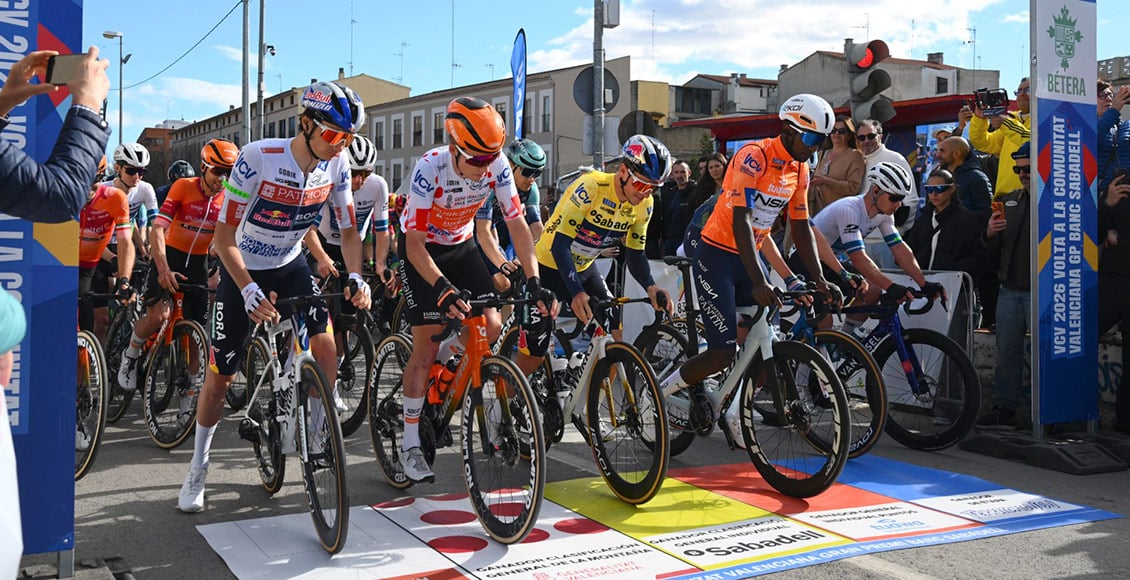
Remco Evenepoel extended his scorching early-season racing start by sealing overall victory at Volta a la Comunitat Valenciana. The Belgian accomplished this by leveraging his enviable aerodynamics and raw power to ride away from UAE’s João Almeida and an elite group to win Stage 4 with a gap large enough to seal the overall victory. While the race itself may not rank among the season’s most consequential, it capped off a month of dominance from Evenepoel and further cemented his authority at Red Bull–BORA–Hansgrohe just weeks into the new arrangement. Valenciana also delivered Movistar its first non-national championship victory since last June, thanks to Raúl García Pierna grabbing an impressive win on the final stage. This highlights a stark reality in modern cycling: the Red Bull superteam is piling up wins while the more traditional Movistar squad, outgunned in both a financial and sports science sense, is still struggling to score even a handful of wins each season. Next up is the first big WorldTour showdown of the season, where Evenepoel will face off against UAE’s up-and-coming star Isaac del Toro at the UAE Tour.
 Matthew Riccitello steps into a leadership role with his new team Decathlon
With the 2026 professional road cycling season heating up, our sister publication, Beyond the Peloton, took stock of American cycling at the sport’s highest level. As has been the case for the last few seasons, the picture is more nuanced than the raw numbers suggest. While total U.S. representation in the WorldTour remains near a 20-year low, it ticked up modestly to 14 riders in 2026 after bottoming out at 12 in 2025. But, more importantly, the underlying story is one of unprecedented quality, not one of decline. American riders are producing results at a level not seen in nearly two decades, driven by figures like Matteo Jorgenson and Brandon McNulty, who regularly win WorldTour races and help to anchor the sport’s most powerful teams. American riders are spread across more individual teams than ever, reflecting the collapse of U.S.-registered WorldTour teams rather than a lack of talent; the average American rider has never been stronger, with points-per-rider metrics surging to all-time highs. Crucially for certain riders, pathways to team leadership remain open: Jorgenson at Visma, McNulty at UAE, Quinn Simmons at Lidl-Trek, and Matthew Riccitello at Decathlon. In each case, Americans are no longer just support riders, but core contributors. Add in a youth cohort now transitioning from promise to performance, and the paradox of the current era becomes clear: American cycling’s domestic infrastructure may have withered, and there may only be a single U.S.-registered WorldTour team in 2026, but U.S. riders’ influence and relevance at the top of the sport continue to rise.
The Regional Sports Networks that provided many pro sports league franchises with broadcast revenues have essentially collapsed in recent weeks, and the immediate fallout could impact niche sports like cycling. Main Street Sports – the RSN broadcast operator of FanDuel Sports – has lost nearly all of its Major League Baseball partners as of last week with over two dozen more teams from the NBA and NHL facing similar decisions soon. Reportedly, eight more baseball franchises have migrated their media rights into MLB network’s native streaming platform. Consolidating the majority of its franchise media rights has been a key MLB objective as a bargaining chip needed to extract greater value when the league re-competes exclusivity for the next big broadcast contract in 2028. And this is absolutely necessary due to skyrocketing player contract commitments and revenue limitations faced by small market teams. As we’ve covered in earlier AIRmail editions, the licensing fees have outpaced broadcaster revenues as terrestrial/cable distribution shrinks and consumers reconsider subscribing to multiple streaming services, all of which proportionately reduces licensing payments to the teams.
That intersection of rising team payrolls, distribution constraints, and monetization of media licensing fees has now reached a critical point – and two immovable obstacles now stand in every sport’s way. The NFL’s dominance in the media market is only going to get stronger as it internationalizes and potentially adds more games to the season, even eating into FIFA’s global domain. But now the wild acceleration of NCAA football’s economics has crowded the market, and networks must essentially commit the majority of their rights investments into two simultaneous professional leagues in the same sport. To wit, the Fox Network has stated that it will “rebalance” its portfolio of sports rights holdings to compete for a share of the next NFL media rights package, currently worth $111 billion. Fox and the other major networks will have to shed unprofitable investments in other sports to focus on a core football product, especially as NCAA conferences demand ever-higher fees. The MLB, other leagues, and even sports like tennis will struggle to overcome this artificial economic ceiling as they find fewer broadcasters willing to bid upwards, which will suppress those sports’ value and profitability.
Ultimately, this trend could exacerbate pressure on niche sports like cycling, as it will be increasingly difficult to find broadcasters or networks interested in including cycling subscriptions. But, as we’ve said before, stressed business conditions always open the door for innovation. Cycling’s stakeholders should be investigating all opportunities – to make the sport attractive to new fans, broadcasters, and most importantly, new investors.

News landed last week that the UCI will be studying the feasibility of using cyclists’ power meter data to bolster doping detection. While that sounds progressive, it’s nothing new; physiology and medical experts have been pursuing this option for years. Using power data to provide a measure of changing rider performance first arose when limitations of the biological passport became clear. Initially, it was medical treatment innovations that artificially elevated and/or held key biometric parameters above the athlete’s baseline norm so as to avoid detection. Later, such testing approaches became very expensive – for sport governance bodies and anti-doping agencies to litigate cases all the way up to the Court of Arbitration for Sport (CAS).
We first analyzed power’s potential in 2018, and the same challenges for adoption exist today – the most glaring of which are standardization of the measurement tool and centralization of the data and its detection algorithms. There can be wildly fluctuating results from the different power meters on the market; hence, any adoption of a power-based cheating detection methodology must be accompanied by a transparent vendor competition, so that performance measurements and data handling and storage procedures can be authenticated. Tacitly, that power meter accuracy and reliability competition winner will artificially skew the market against its competitors, an outcome that will almost certainly land in litigation. And as the UCI discovered with its proposed gearing restriction and SRAM’s subsequent legal victory that effectively nixed the statute, meddling with the consumer product landscape is not a governing body’s strong suit.
The UCI provided no answers when we asked how it selected its “safety tracking” technology device and vendor last year – an equally consequential technical decision impacting the sport’s integrity. Hence, we’re not holding our breath that any further technical assessment details are forthcoming. Doping news has been thin in pro cycling over the past few seasons, with just a few low level blemishes hovering below the scandal threshold. Could the adoption of power as a detection tool cast a better net? As mentioned, the cost of litigation is increasing, not only to adjudicate the anti-doping cases but also the potential for lawsuits against sporting bodies by athletes exonerated in the Swiss court – in addition to consequences measured by reduced fan trust, drop in viewership, and loss of sponsor investment. There is other low-hanging fruit in the anti-doping battleground which is not being effectively used, such as drug anti-diversion efforts that can pinpoint doping medication sources and lead directly to teams and individual athletes. Even so, the addition of power as a detection method should be welcomed if effectively implemented; with the Enhanced Games about to blur the lines between natural sport and cultural acceptance of doping, anything that cycling can do to promote the image of clean competition should be adopted before the narrative changes.

There was news last week of a new digital AI-powered camera device that could potentially make cycling safer. Luna Systems has plans to take cycling safety to the next level, and provide “greater situational awareness through detection of blind spots, close passes, and headway distances.” A rear-facing camera connects to the user’s handlebar-mounted smartphone that in turn provides the rider with audio alerts. The rider would benefit from “proximity warnings, collision and pothole warnings, intelligent evidence recording, post-ride mapping of incidents, and blackspot identification.” Luna says that the system would mimic the types of safety systems that we already see built into higher-end automobiles, like blind spot monitoring and forward collision detection. Sounds great – if it actually works and if it doesn’t cost an arm and a leg. The company has apparently raised almost $2 million in funding and company officials say a prototype product should be available by later this year. And we wonder if a future version of this technology – tuned for racing environments and able to automatically toggle between different views and alerts from inside the peloton – could provide innovative and exciting race coverage options while enhancing rider safety.
The post OUTERLINE: Evenepoel Dominates, U.S. Riders Rise, and Cycling Tech Hits the Road appeared first on PezCycling News.