
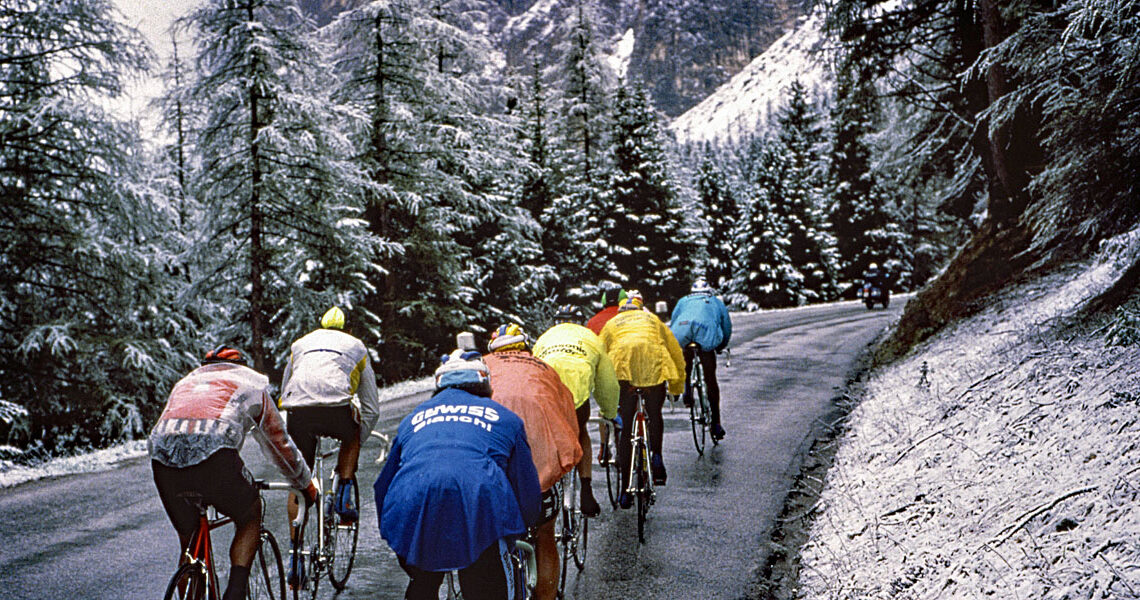

Well, this past week I’ve just finished shovelling white fluffy stuff that some joker laid down on my driveway. Danged kids. Anyway, it seems like a good time to go over some rules concerning exercising outdoors in the cold and also indoors on the trainer…

How Cold is Too Cold?
There’s a train of thought out there that there’s no such thing as bad weather, only bad clothing. I’m usually in agreement with that sentiment, but that kind of rhetoric is often spouted by people living in places where 7°C and having to wear arm warmers is considered an ice age. Growing up in Vancouver and now living in southern Ontario, I’ve gotten more than my fair share of nasty cold rain, deep snow, and severe wind chill. When it’s too cold, there’s simply no point in fighting the elements, because there’s a fine line to play between building toughness and getting sick.
But within reason, exercising outdoors even in the extreme cold is both doable and maybe even enjoyable, as Andy Hampsten discovered on the Gavia in the 1998 Giro. Besides tales to tell your grandkids, it gets us away from that dreaded trainer.
Psychologists studying Seasonal Affective Disorder consistently urge getting outside to avoid the depression that comes from shutting ourselves indoors in the winter, so let’s hit the great outdoors armed with some common sense!
The Iceman Cometh
My research focuses on extreme heat and also extreme cold, so half the time I’m freezing my poor participants in the lab. And like clockwork, every winter the media calls me up to comment on the latest case of somebody suffering or dying from severe hypothermia. If you don’t want to be a subject of mine, here are some guidelines to consider when exercising out in the cold.
Breathing the Cold Air
A very nice study back in the early 1980s demonstrated that there is minimal to no negative effects from inhaling very cold air during exercise (1), as the nasal passage and the airways are very effective at warming up the air before it reaches the lungs. So if it is cold and dry, there are no problems with going out cross-country skiing, snowshoeing, or cycling as long as you dress appropriately and bring enough food and drinks with you.
Cold dry air can be a trigger for asthma and also exercise-induced bronchoconstriction. If you are prone to either, one thing to try is to warm up indoors and get your respiratory system adjusted to higher ventilation in warm and humidified air before giving it the double dose of cold/dry and high ventilation. A mask or a buff can also slow down the rate of cold air going into your airways.

Blowing in the Wind
Wind chill is the big risk when exercising in the winter, because wind greatly increases the rate of heat loss from your skin and the risk for frostnip and frostbite (2). Consider ditching the road bike, which is generally on exposed roads, and build up a mountain bike for ice/snow biking that gets you into tree-covered trails. My favourite winter activities are snowshoeing and cross-country skiing, which gets me out into the trails and gives me great cross-training benefits for both the cardiovascular system and the legs.
When it’s cold, the real limiters for me are my hands and feet. I can’t believe it took me 35 years of cycling before I got myself a set of Bar Mitts – big neoprene “pogies” that form a hood over your hoods and handlebars. That’s greatly extended the temperature range that I can handle.
For my feet, I generally stick with one pair of thick merino wool socks paired with a specific winter MTB shoe. On the rare occasions when I ride my road bike in the winter, I go with MTB pedals and winter shoes in case I get stuck needing to walk.
But honestly, why would I ride my road bike when I can ride my gravel bike with fatter and grippier tires in uncertain winter conditions? My gravel bike also has tubeless tires rather than the tubed clinchers on my road bike, greatly decreasing the odds of me stuck by the side of the road fixing a flat with frozen fingers. And the heavier slower gravel bike means less wind chill.
Water and Sweat
Be extremely careful when it’s cold and raining or when you are near water. Water conducts heat 25 times as fast as air (that’s why a 15°C room is not too bad but a 15°C pool is brutal), greatly increasing your risk of hypothermia. If it’s a cold and wet day, consider doing something indoors instead, or make sure you have excellent rain gear. When it’s cold and wet, also try to keep stops or rest breaks to a minimum, as the act of exercising is generating a lot of valuable heat to keep you warm.
Make sure you wear quality winter underclothing that is going to wick the sweat away from your body, because the trapped sweat is also going to cool you down rapidly. With the advances in clothing technology, there’s almost no excuse for going out unprepared.
Layering definitely does work. Each individual layer acts as a barrier to wind, and the sum of a few layers is usually greater than one single layer of the same overall insulation. Layering also lets you customise the degree of ventilation during exercise.
Last but not least, listen to your mom and wear a hat under your helmet, especially with all the super-ventilating helmets out on the market. It’s not that you lose disproportionately a lot more heat from the head area, but simple logic says that if you have exposed skin it’s going to be a site for heat loss. I won’t name and shame, but I have a “summer” helmet that’s so poorly ventilated that I keep it specifically for winter riding. And when it gets really cold, I swap to my snowboarding helmet.
So get out there and imagine you’re Andy!

References
1. Hartung GH, Myhre LG, and Nunneley SA. Physiological effects of cold air inhalation during exercise. Aviat Space Environ Med 51: 591-594, 1980.
2. Noakes TD. Exercise and the cold. Ergonomics 43: 1461-1479, 2000.
The post Training in the Cold appeared first on PezCycling News.